
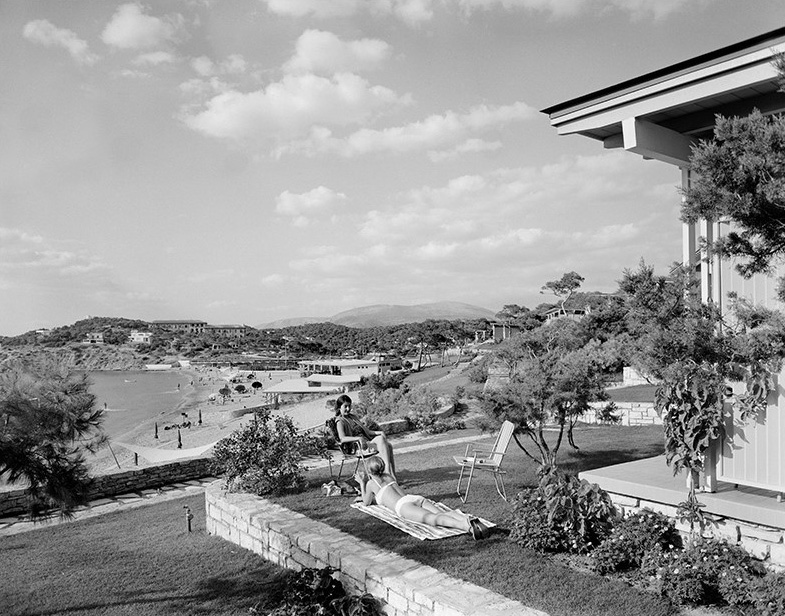

Online International Seminar
Following the very strong participation in the session we organised in June 2024 as part of the international conference of the European Architectural History Network (EAHN), we have decided to pursue this line of research in the form of an online seminar. This format will allow us to continue the collective reflection initiated during the conference and to further explore the transnational, architectural, political and economic dimensions of tourism and leisure infrastructures in the Mediterranean context.
Présentation
Des stations balnéaires et des lieux de villégiature bourgeois, la période de l’après-guerre a vu l’émergence de l’industrie des loisirs de masse — et, bien plus tard, du secteur mondialisé des complexes touristiques de luxe. La généralisation des congés payés, l’essor des classes moyennes et le rôle croissant du tourisme comme moteur du développement économique ont largement contribué à cette nouvelle configuration. Des régions entières ont été transformées afin de fournir les infrastructures nécessaires au voyage, notamment les réseaux routiers et aéroportuaires, mais aussi des équipements commerciaux et culturels tels que des bâtiments dédiés au commerce, des ensembles résidentiels, des musées et des infrastructures de loisirs. L’architecture touristique s’est alors entremêlée à celle dédiée aux loisirs, formant un système complexe qui, dans de nombreux cas, demeurait accessible aux populations locales — une condition aujourd’hui largement disparue.
Dans chaque pays, l’État a joué un rôle plus ou moins déterminant dans la mise en œuvre de politiques publiques spécifiques au tourisme. Les rapports nationaux à l’histoire et au patrimoine architectural ont fortement varié, mais ces questions ont constitué des enjeux centraux, dans la mesure où elles étaient étroitement liées aux processus de modernisation et à la construction — ou, plus précisément, à la fabrication — de récits nationaux dans la période qui a suivi la Seconde Guerre mondiale.
Les pratiques de loisirs de masse ont toutefois touché l’ensemble de l’Europe, ainsi que plus largement les pays du pourtour méditerranéen, tout au long de l’après-guerre et durant la seconde moitié du XXᵉ siècle.
Cherchant à dépasser les cadres strictement nationaux et à établir des connexions entre différents contextes, le séminaire s’organise autour de trois thématiques transversales visant à favoriser le dialogue entre perspectives géographiques, disciplinaires et temporelles :
- la dynamique de circulation et de transfert des modèles et des typologies autour du bassin méditerranéen ;
- la structuration des modèles économiques, des procédures législatives et des objectifs des politiques étatiques dans le temps ;
- le passage de la propriété publique à l’investissement privé et ses relations avec les formes architecturales.
English
From seaside resorts and bourgeois holiday destinations, the post-war period witnessed the emergence of the mass leisure industry—and, much later, the globalised luxury resort sector. Paid holidays, the rise of the middle classes, and the growing role of tourism as a driver of economic development all contributed to this new condition. Entire regions were transformed to provide the infrastructure required for travel, including road networks and airports, as well as commercial and cultural facilities such as retail buildings, residential developments, museums, and leisure amenities. Tourist architecture became intertwined with leisure-oriented architecture, forming a complex system that was, in many cases, accessible to local populations—a condition that has largely disappeared today.
In each country, the State played a stronger or weaker role in the implementation of tourism-related public policies. National approaches to history and architectural heritage varied significantly, yet these issues were central, as they were closely linked to processes of modernisation and to the construction—more precisely, the fabrication—of national narratives in the period following the Second World War.
Mass leisure practices, however, affected Europe as a whole, as well as Mediterranean countries more broadly, throughout the post-war period and the second half of the twentieth century.
Seeking to move beyond strictly national frameworks and to establish connections between different contexts, the seminar is structured around three cross-cutting themes that aim to foster dialogue across geographical, disciplinary and temporal perspectives :
- the dynamics of circulation and transfer of models and typologies around the Mediterranean basin ;
- the structuring of economic models, legislative procedures and the objectives of state policies over time ;
- the shift from state-owned properties to private market investment, and its relationship with architectural forms.
